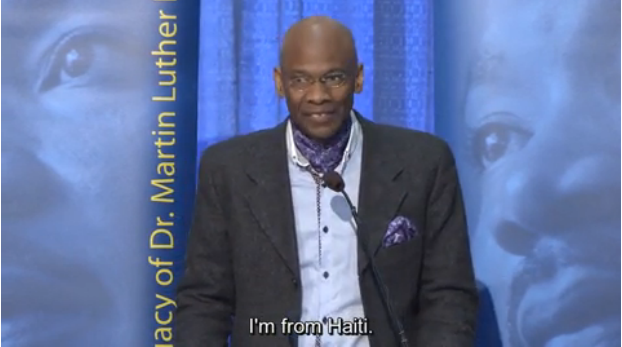
Video by George Zaidan on the MIT-Haiti Initiative which aims to develop, evaluate and disseminate Open Educational Resources in Kreyòl in order to enhance the capacity for Science, Technology, Engineering & Math (“STEM”) teaching and learning in Haiti. This 6-minute video sketches the rationale, methods and aspirations of the Initiative, a project funded mainly by the U.S. National Science Foundation: INSPIRE: Kreyol-based Cyberlearning for a New Perspective on the Teaching of STEM in local Languages and also by MIT, the Wade Fund, the Open Society Foundations, and the Foundation for Knowledge and Liberty (FOKAL) in Haiti.
Ayiti Pare (Haiti is ready)
MIT and Haiti sign agreement to promote Kreyòl-language STEM education
Peter Dizikes, MIT News
April 17, 2013
MIT and Haiti signed a new joint initiative today to promote Kreyòl-language education in the science, technology, engineering and math (STEM) disciplines, part of an effort to help Haitians learn in the language most of them speak at home.

From left to right: Director of MIT’s Office of Educational Innovation and Technology Vijay Kumar, MIT Provost Chris Kaiser, Haiti Prime Minister Laurent Lamothe, MIT Linguistics Professor Michel DeGraff and Haiti Minister of National Education and Vocational Training Vanneur Pierre at the signing of a joint commitment to an initiative for digital learning in Kreyòl.
“This government will make every effort to make this initiative a big success,” Haitian Prime Minister Laurent Lamothe said at the signing ceremony in MIT’s Vannevar Bush Room. “Haiti is moving forward.”
The project is taking MIT-developed and technologically based open education resources, translating those materials into Kreyòl, disseminating them in Haiti, and evaluating the materials’ effectiveness. The work is being done in conjunction with professors and educators from a variety of institutions in Haiti, including the State University of Haiti, Université Caraïbe, École Supérieure d’Infotronique d’Haïti, Université Quisqueya, NATCOM and the Foundation for Knowledge and Liberty.
“MIT folks are very collaborative,” MIT Provost Chris Kaiser said at the event. The initiative, he added, represented MIT’s “desire to do good in the world.”
The idea that more Haitian education should occur in Kreyòl is a longtime belief of MIT linguistics professor Michel DeGraff, a native of Haiti, who has contended that Kreyòl has been improperly marginalized in the Haitian classroom. DeGraff’s extensive research on public perceptions of Kreyòl, and on the language itself, has led him to assert that its perception as a kind of exceptionally simplified hybrid tongue, in comparison to English or French, unfairly diminishes the language.
The initiative is meant not to replace French, DeGraff added, but to help Kreyòl-speaking students “build a solid foundation in their own language.”
The technology-based open education resources, he noted, are meant to promote “active learning,” as opposed to drill-based rote learning techniques.
The initiative is being funded by the U.S. National Science Foundation and by MIT.
Alongside DeGraff, the project has been developed with the guidance of Vijay Kumar, a principal investigator of the MIT-Haiti Initiative for Kreyòl-based and technology-enhanced STEM education and director of the MIT Office of Educational Innovation and Technology, and Thomas Kochan, the George Maverick Bunker Professor of Management at the MIT Sloan School of Management and co-director of MIT’s Initiatives in Haiti, coordinating such efforts across the Institute.
New educational resources are badly needed in Haiti, especially after the January 2010 earthquake that devastated the country, Lamothe noted. Rebuilding with Kreyòl-language educational tools will help provide “access to quality education for all,” given that 97 percent of Haitians speak Kreyòl. About 50 percent of Haitians have an income of less than $1 per day.
Lamothe added: “The most productive partnership for Haiti [is] about empowering Haitians to fly with their own wings.”
Reprinted with permission of MIT News. Photos Courtesy of Dominick Reuter.
January 2013 Workshops
MIT hosted workshops on technology-enhanced and open education from January 16–19, 2013 in Port-au-Prince, Haiti.
This is the second of a 5-year series of workshops whose main goal is to implement and evaluate faculty- and curriculum-development activities based on Kreyòl-based Open Education Resources for science and math courses in Haitian schools and universities. How can these resources be most constructively used to improve science and math courses in Haiti? How can similar resources be designed in situ by educators in Haiti and become fully functional and sustainable?
These workshops are based on specific samples of courses and resources from MIT. This time around, the sample will consist of workshops in math (differential equations), physics (electro-magnetism, electric circuits and Newtonian mechanics) and biology (biochemistry and genetics). To help achieve full mastery of the materials, we will organize hands-on exercises based on them. We will also use this opportunity to develop a long-term evaluation plan in collaboration with our colleagues in Haiti.
An MIT–Haiti Initiative Toward Active Learning for All
MIT Professor of Linguistics Michel DeGraff and Dr. M.S. Vijay Kumar of the Office of Educational Innovation and Technology presented on the MIT-Haiti Initiative at the Globally Engaged MIT Symposium on September 20, 2012. The symposium focused on how “MIT’s history of changing the world through community and global engagement has led to new collaborations, educational programs, research, scholarship, and service opportunities across all disciplines and departments.”
Q&A with Michel DeGraff
Kathryn O’Neill of the MIT School of Humanities, Arts and Social Sciences writes:
Recipient of $1m NSF grant for linguistics research, and development
of active-learning resources for science and math in KreyòlKi fèk reservwa $1 milyon nan men NSF pou rechèch lengwistik epi pou
kreyasyon zouti pou aprantisaj aktif syans ak matematik an kreyòlMIT Associate Professor of Linguistics Michel DeGraff recently received a one million-dollar grant from the National Science Foundation for his linguistics research in Haiti, which includes developing classroom tools to teach science and math in Haitian Creole (Kreyòl) for the first time. We spoke with him about his vision for the research, about the Kreyòl language, and the future of education in Haiti.
Also appears in MIT News, Q&A: Michel DeGraff on teaching STEM in Kreyòl: A model for reaching science-hungry students around the world who speak local languages.
MIT-Haiti team receives funding for Kreyòl-based STEM Cyberlearning
The grant will enable faculty and researchers from MIT to create ‘a set of Haitian Creole-based, technology-enabled active-learning resources for STEM higher education in Haiti.’
Prof. Degraff says:
“This NSF grant is a fantastic opportunity. It’s going to help transform higher education in Haiti through Open Education Resources in Haitian Creole. Thanks to groundbreaking teamwork among faculty and education leaders at MIT and Haiti, the Office of Educational Technology & Innovation and the Teaching & Learning Lab, we are introducing and evaluating Haitian Creole-based content in Science, Technology, Engineering and Math (“STEM”). We are doing this with new active-learning pedagogies through educational technologies developed at MIT, such as STAR for Biology, TEAL for Physics, Mathlets for Math and Educational Games. By using online Open Resources, we’re making these materials available to the largest possible audience in Haiti. These resources match the needs identified by our partners and colleagues in Haiti. And we are introducing these resources with an essential ingredient: Haitian Creole—the one language that all Haitians are fluent in. As far as I know, this is the first initiative ever to introduce online Kreyòl materials for advanced STEM in higher education in Haiti.”
In addition, ‘a variety of fundamental research questions are being addressed, pertaining to (i) the effects, impacts, and challenges of creating opportunities to learn in one’s mother tongue, especially when it does not already contain relevant vocabulary (ii) the creation and diffusion of scientific and technical vocabulary in languages without technical words, called ‘language engineering’, (iii) technical and socio-technical issues in adapting and incorporating learning technologies into the learning environments of underserved populations.’
And there are larger potential rewards. Prof. Degraff continues:
“There are millions of other students worldwide who speak local languages, like Haitian Creole, and who are thirsty for science, as in Haiti. Our project will thus serve as a model beyond Haiti. Furthermore our project illustrates the potential for scientists, engineers and humanists to collaborate and bring out our best in addressing enduring problems of the world.”
MIT Visit in Le Nouvelliste
The recent workshop hosted by MIT was written about in one of the main Haitian newspapers Le Nouvelliste:
Une équipe de sept professeurs du Massachussetts Institute of Technology a organisé deux journées de formation pour de 54 professeurs de biologie et de physique les 29 et 30 mars 2012. Cette initiative vise à rendre l’éducation plus pratique et plus moderne, selon le professeur de linguistique Michel DeGraff.
Read more … Pour une éducation pratique et moderne
TEAL Workshops in Haiti
On March 29-30, 2012, Peter Dourmashkin, MIT, presented interactive workshops on Technology Enabled Active Learning (TEAL) to 38 participants from Haitian schools and universities.
For the past ten years the Physics Department at MIT has developed a program called Technology Enabled Active Learning (TEAL) which has fundamentally changed the way the introductory Newtonian Mechanics and Electricity and Magnetism physics courses are taught at MIT. TEAL represents an attempt to incorporate a variety of new teaching ideas and technologies into first-year physics subjects. The course is a non-lecture based course with an emphasis on active engaged learning. Students work together in groups of three, using tabletop experiments and computer-based visualizations to develop their conceptual and analytic understanding of mechanics and electricity and magnetism. The syllabus is designed to integrate concepts, experiments, and problem solving skills in an interactive learning environment in which students regular discuss concepts and problems in class with their teachers. All of the course materials are now available in OCW Scholar. These workshops focused on describing TEAL and in particular how the TEAL materials on OCW Scholar can be adapted for use in teaching physics in many institutional settings.
About the Workshops
The main goal of these workshops was to start implementing faculty- and curriculum-development activities based on MIT’s Open Education Resources such as OpenCourseWare and Software Tools for Academics and Researchers. How can these resources be most constructively used to improve STEM courses in Haiti? How can similar resources be designed in situ by educators in Haiti and become fully functional?
STAR Workshops in Haiti
The STAR (Software Tools for Academics and Researchers) program seeks to bridge the divide between scientific research and the classroom. Our multidisciplinary team, consisting of research-trained scientists and software engineers, collaborates with MIT faculty to design innovative and intuitive software tools for classroom use. The STAR educational tools are FREELY available. In addition to the software, the STAR web site contains educational materials that help incorporate these tools into various educational settings. The workshop highlighted two biology STAR tools: StarBiochem and StarGenetics. StarBiochem is a molecular 3D viewer that allows students to learn key concepts about the biology of molecules and proteins in an interactive manner. StarGenetics is a virtual genetics laboratory where students can simulate mating experiments and actively explore a wide array of genetics concepts.
The workshop covered the following items for each tool:
- the rationale for designing the tool
- the design process
- how to access the tool and supporting educational materials
- tour of the tool
- hands-on activity with an example exercise
- examples of how the tool is currently being used
- how to build custom exercises
About the Workshops
The main goal of these workshops was to start implementing faculty- and curriculum-development activities based on MIT’s Open Education Resources such as OpenCourseWare and Software Tools for Academics and Researchers. How can these resources be most constructively used to improve STEM courses in Haiti? How can similar resources be designed in situ by educators in Haiti and become fully functional?
Workshops on Technology-Enhanced and Open Education
From March 28-31, 2012 faculty and staff from MIT visited Haiti to present workshops on STAR (Software Tools for Academics and Researchers), TEAL (Technology Enhanced Active Learning) and Open Education to over fifty educators from Haitian universities and schools.
About the Workshops
The main goal of these workshops was to start implementing faculty- and curriculum-development activities based on MIT’s Open Education Resources such as OpenCourseWare and Software Tools for Academics and Researchers. How can these resources be most constructively used to improve STEM courses in Haiti? How can similar resources be designed in situ by educators in Haiti and become fully functional?


Unless otherwise stated the